Abdullah Gul and the Making of the New Turkey by Gerald MacLean
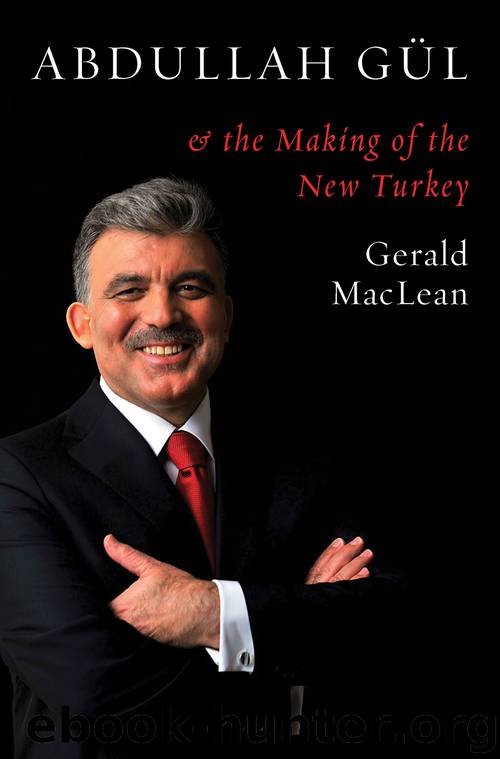
Author:Gerald MacLean
Language: eng
Format: epub
Tags: Politics, Turkey, Islam, Political biography, Modernity, Democracy, International Politics, Middle East, EU
Publisher: Oneworld Publications
Published: 2014-08-19T00:00:00+00:00
Amid the fears and confusions arising from investigations into the accident at Susurluk, the generals finally moved when their fears of political Islam were provoked too far by a municipal event in Sincan, a small town outside Ankara.
On 30 January 1997, the Refah mayor of Sincan – one Bekir Yıldız, an opportunist Islamist and not Gül’s high-school friend from Kayseri – had organized a ‘Jerusalem Night’ with speeches enthusiastically calling for the liberation of the holy city from Israel. Such rallies with their strong language were not unusual in Refah strongholds where Erbakan’s fiercely anti-Zionist rhetoric captured votes. But among the invited guests was the Iranian ambassador, and the army were not amused. Two days later, their tanks rumbled through the streets of Sincan.13 On 28 February, at an extraordinary meeting of the Cabinet, the National Security Council presented Erbakan and Çiller with a detailed memorandum of measures to suppress ‘religious reaction’ (irtica) that the government was herewith to enforce: an ultimatum that Erbakan was forced to sign.
Detailed evidence about who did what leading up to and during the events of 28 February 1997 was still being revealed during trial hearings that began in April 2012. But the major implications soon became clear enough: in the name of protecting the secular status of the republic from encroaching threats, the army had overthrown the government without taking up arms or even leaving the barracks in a virtual and hence ‘postmodern’ coup. The constitutional reforms of 1982 had established the militarized National Security Council as a ‘permanent organ of the state’ with executive authority to regulate government affairs, powers that rendered a physical coup needless. At a nine-hour meeting, Erbakan and Çiller were informed that irtica, extreme ‘religious reaction’, had become the greatest threat to the state.
Since many feared that the secular republic was clearly in danger of being about to be taken over by political Islam, the National Security Council proposed measures that the Cabinet would have to take: these included tightening control over Islamic brotherhoods, closing religious Imam Hatip Schools (which had originally been established after the 1980 coup as a bulwark against communism!), marginalizing the conservative businessmen of central Anatolia (the so-called ‘green’ capital of the Islamic Calvinists), and shutting down Qur’an courses and all media outlets perceived to be anti-secular.14 The National Security Council memo also outlined plans to appoint the ‘Western Working Group’ (Batı Çalışma Grubu), a body of unnamed ‘intelligence experts’ to be funded and given the task of seeking out and investigating ‘threats from radical Islamists throughout the country and abroad’: this group was reported to be still active in 2000.15 Days went by and the generals grew impatient at Erbakan’s delay in ratifying their executive demands while he launched a last-ditch attempt to rally support for a ‘democracy’ campaign among leaders of the other parties. As sociologist Haldun Gülalp comments: ‘Testifying to the lack of democratic culture in the Turkish political mainstream, none of the other parties were interested in searching for a common platform of democratization with Refah.
Download
This site does not store any files on its server. We only index and link to content provided by other sites. Please contact the content providers to delete copyright contents if any and email us, we'll remove relevant links or contents immediately.
Waking Up in Heaven: A True Story of Brokenness, Heaven, and Life Again by McVea Crystal & Tresniowski Alex(37810)
Empire of the Sikhs by Patwant Singh(23086)
We're Going to Need More Wine by Gabrielle Union(19046)
Hans Sturm: A Soldier's Odyssey on the Eastern Front by Gordon Williamson(18591)
Leonardo da Vinci by Walter Isaacson(13336)
The Radium Girls by Kate Moore(12028)
Tools of Titans by Timothy Ferriss(8395)
Educated by Tara Westover(8054)
How to Be a Bawse: A Guide to Conquering Life by Lilly Singh(7486)
Permanent Record by Edward Snowden(5847)
The Last Black Unicorn by Tiffany Haddish(5635)
The Rise and Fall of Senator Joe McCarthy by James Cross Giblin(5280)
Promise Me, Dad by Joe Biden(5153)
The Wind in My Hair by Masih Alinejad(5095)
A Higher Loyalty: Truth, Lies, and Leadership by James Comey(4964)
The Crown by Robert Lacey(4817)
The Iron Duke by The Iron Duke(4356)
Joan of Arc by Mary Gordon(4110)
Stalin by Stephen Kotkin(3965)
